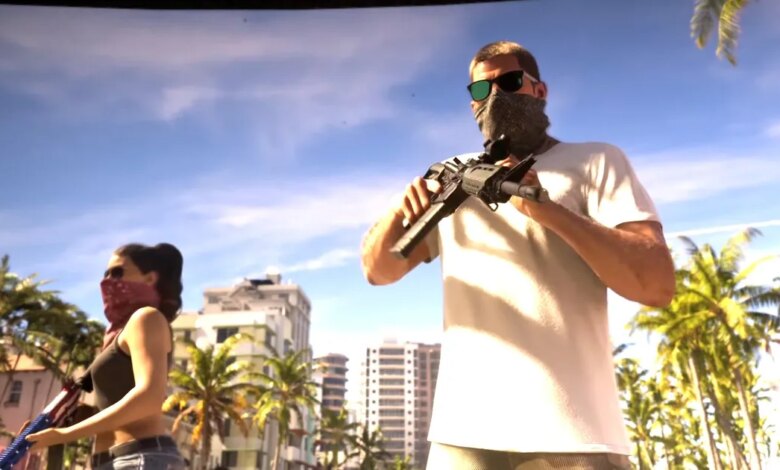
Rockstar’s Grand Theft Auto VI Showcase Reveals How Decades of Studio Design Power Modern Vice City
The release of a comprehensive 26-minute gameplay demonstration has provided the clearest look yet at how Rockstar Games is constructing Grand Theft Auto VI. Captured entirely from in-game footage running on PlayStation 5 hardware, the showcase moves through high-stakes armed heist sequences, quiet character interactions, open-world exploration, and high-speed pursuits across the fictional state of Leonida. Far from merely serving as a graphical benchmark, the extended preview demonstrates how Rockstar is synthesizing mechanical systems, animation philosophies, and narrative frameworks honed across its past titles into a singular modern crime simulation.
Rather than discarding established formulas, Grand Theft Auto VI builds directly upon structural choices established in Red Dead Redemption 2, Grand Theft Auto V, Max Payne 3, and Grand Theft Auto: San Andreas. By merging these distinct design lineages, the project aims to balance granular world interactivity with complex character mechanics, anchored by a dual-protagonist narrative that fundamentally alters how missions are approached.
The Bonnie and Clyde Dynamic: Coordinated Mechanics and Character Synergy
At the center of Grand Theft Auto VI are dual protagonists Jason and Lucia, whose relationship serves as both the narrative engine and the core gameplay foundation. Narrative lead Rupert Humphries has explicitly framed their storyline around a classic Bonnie-and-Clyde structure, a design choice reflected continuously throughout mission execution and ambient traversal. Unlike previous titles where character switching often separated protagonists into distinct physical spaces, Jason and Lucia operate primarily as an active tactical pair.
The showcase demonstrates how their complementary skill sets influence mission flow. Jason routinely assumes the role of direct combat support, managing heavier armed security and high-caliber firefights. Lucia’s sequences prioritize movement, agility, non-lethal stealth, and evasive driving. This division of responsibility becomes particularly visible during a featured corporate event mission. When security confiscates Lucia’s weapons at entry, an unexpected assault forces her to navigate the facility using close-quarters combat, stealth movement, and environmental hazards while Jason engages enemies elsewhere in the structure, at one point tossing an explosive into an elevator shaft to create a diversion for her escape.
Beyond tactical combat, the partnership extends into off-mission downtime and survival mechanics. Dialogue between the two continues dynamically whether they are driving, executing criminal jobs, or unwinding in their shared apartment. Furthermore, the game incorporates survival and physical conditioning systems reminiscent of Grand Theft Auto: San Andreas. Prolonged periods on the run, lack of rest, and physical exertion visibly impact character appearance and stamina, forcing players to manage physical maintenance alongside criminal operations.
Synthesizing Rockstar’s Mechanical Legacy
Observation of the extended gameplay footage reveals how explicitly Grand Theft Auto VI integrates technical solutions from across Rockstar’s software portfolio. Rather than functioning as a direct sequel to Grand Theft Auto V alone, the game draws specific gameplay loops from several distinct eras of the studio’s catalog:
Max Payne 3 Indoor Gunplay: Interior shootouts feature tight cover transitions, precise free-aim mechanics, cinematic kill cameras, and context-sensitive slow-motion sequences during critical tactical breach points.
Red Dead Redemption 2 Environmental Physics: Character animations possess tangible physical weight, with detailed environmental interactions, realistic stamina management, and living spaces—such as protagonist safehouses—that organically accumulate physical props and clutter over time.
Grand Theft Auto: San Andreas Mission Escalation: Low-level street transactions regularly unravel into city-wide police responses. A routine drug pickup sequence shown in the footage quickly deteriorates as law enforcement surrounds the perimeter, requiring an extended combat retreat and vehicle pursuit across urban sectors.
Grand Theft Auto V Dynamic Character Switching: Perspective shifting evolves from a simple camera transition into an active combat tool, enabling real-time coordination, dynamic tactical callouts, and shared tactical information between Jason and Lucia.
Modern Vice City: Nostalgia Meets Clout Culture
The setting of Leonida and its primary metropolis, Vice City, strikes a delicate balance between iconic regional atmosphere and modern cultural satire. Classic visual markers—neon lighting, palm-lined coastal drives, low-rise beach neighborhoods, and marshland outskirts—are paired directly with sprawling modern commercial centers, high-density residential towers, and contemporary infrastructure.
The satire has been updated to reflect current digital realities. Vice City is depicted as a culture dominated by celebrity obsession, fast fashion, tourism, and real-time social media output. In-game feeds update continuously based on player actions and ambient street events. The cultural shift is woven directly into gameplay set pieces: during one escape sequence, Lucia navigates a high-speed vehicle getaway while dragging along an active livestreaming influencer, transforming a violent getaway into live online content within the game world.
To populate this environment, Rockstar engaged a dedicated performance capture facility in Los Angeles specifically to build dynamic non-player character (NPC) behavior routines. Pedestrians exhibit contextual reactions to weather, local events, wealth disparities across distinct economic districts, and player behavior, creating a world that feels continuously reactive rather than pre-scripted.
Pacing, Systems, and Open-World Considerations
While the 26-minute presentation highlights an extraordinarily detailed open world, it also brings forward questions regarding pacing and mechanical weight. Heavy character animation systems, physical stamina degradation, and detailed environmental interaction add immense immersion, but they can also introduce friction during extended play sessions. Balancing micro-interactions—such as manual item retrieval or physical resource management—against high-pacing arcade driving and combat remains one of the primary design challenges for an open-world game of this scale.
Furthermore, mission structure must accommodate two protagonists with distinct capabilities without restricting player freedom during open-ended encounters. The showcase suggests that Rockstar is addressing this by offering multiple entry angles for combat and stealth scenarios, allowing players to utilize Jason’s firepower or Lucia’s mobility depending on preference and situation.
As the November 19 release date approaches, the extended showcase establishes that Grand Theft Auto VI is built on a foundation of deliberate design aggregation. By combining the tight combat mechanics of Max Payne 3, the systemic depth of Red Dead Redemption 2, and the modern social commentary of the Grand Theft Auto franchise, Rockstar Games aims to deliver a modern benchmark for open-world design.